System Design Patterns
16. CAP Theorem
Let's learn about the CAP theorem and its usage in distributed systems.
1 min read
Background
In distributed systems, different types of failures can occur, e.g., servers can crash or fail permanently, disks can go bad resulting in data losses, or network connection can be lost, making a part of the system inaccessible. How can a distributed system model itself to get the maximum benefits out of different resources available?
Definition
CAP theorem states that it is impossible for a distributed system to simultaneously provide all three of the following desirable properties:
Consistency ( C ): All nodes see the same data at the same time. It is equivalent to having a single up-to-date copy of the data.
Availability ( A ): Every request received by a non-failing node in the system must result in a response. Even when severe network failures occur, every request must terminate.
Partition tolerance ( P ): A partition-tolerant system continues to operate despite partial system failure or arbitrary message loss. Such a system can sustain any network failure that does not result in a failure of the entire network. Data is sufficiently replicated across combinations of nodes and networks to keep the system up through intermittent outages.
Solution
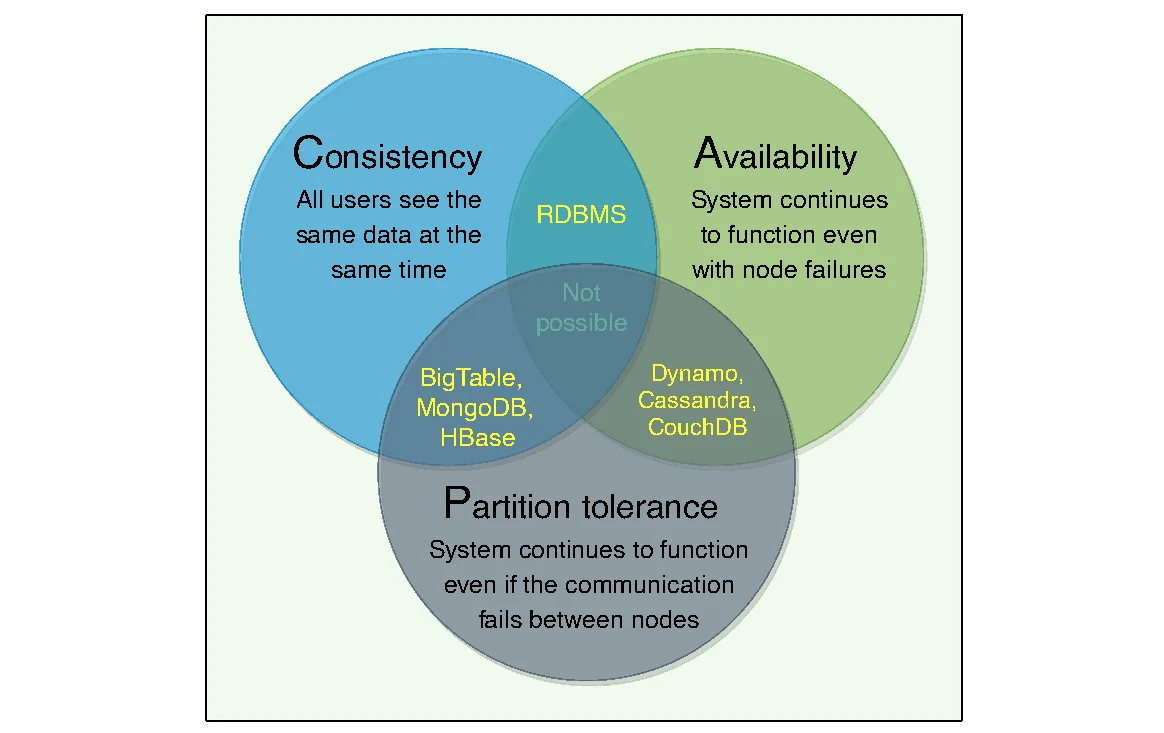
According to the CAP theorem, any distributed system needs to pick two out of the three properties. The three options are CA, CP, and AP. However, CA is not really a coherent option, as a system that is not partition-tolerant will be forced to give up either Consistency or Availability in the case of a network partition. Therefore, the theorem can really be stated as: In the presence of a network partition, a distributed system must choose either Consistency or Availability.
Examples
Dynamo: In CAP theorem terms, Dynamo falls within the category of AP systems and is designed for high availability at the expense of strong consistency. The primary motivation for designing Dynamo as a highly available system was the observation that the availability of a system directly correlates to the number of customers served.
BigTable: In terms of the CAP theorem, BigTable is a CP system, i.e., it has strictly consistent reads and writes.