Chubby
File, Directories, and Handles
Let's explore how Chubby works with files, directories, and handles.
1 min read
Chubby file system interface is basically a tree of files and directories, where each directory contains a list of child files and directories. Each file or directory is called a node.
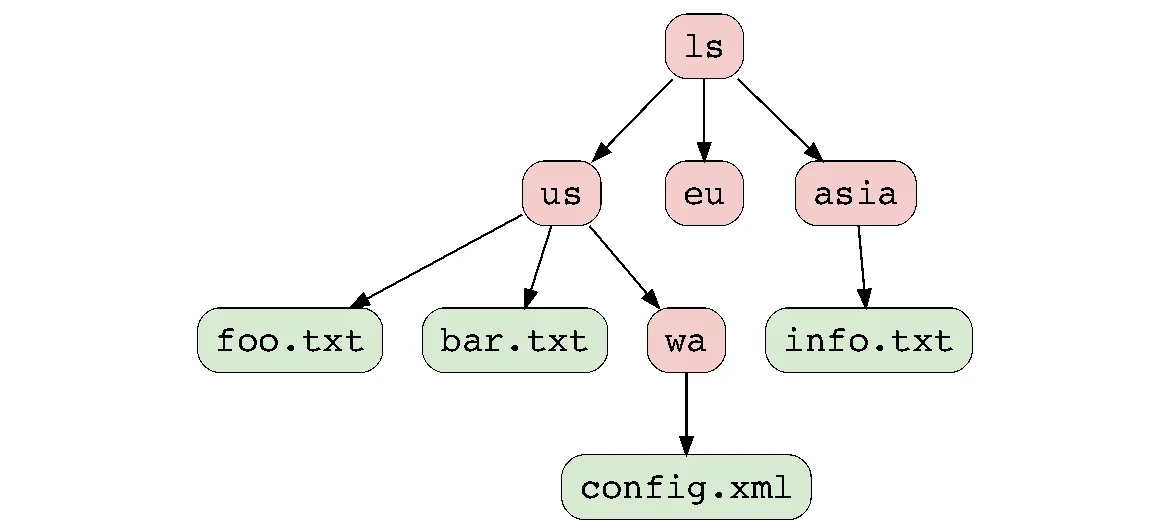
Nodes
- Any node can act as an advisory reader/writer lock.
- Nodes may either be ephemeral or permanent.
- Ephemeral files are used as temporary files, and act as an indicator to others that a client is alive.
- Ephemeral files are also deleted if no client has them open.
- Ephemeral directories are also deleted if they are empty.
- Any node can be explicitly deleted.
Metadata
Metadata for each node includes Access Control Lists (ACLs), four monotonically increasing 64-bit numbers, and a checksum.
ACLs are used to control reading, writing, and changing the ACL names for the node.
- Node inherits the ACL names of its parent directory on creation.
- ACLs themselves are files located in an ACL directory, which is a well-known part of the cell’s local namespace.
- Users are authenticated by a mechanism built into the RPC system.
Monotonically increasing 64-bit numbers: These numbers allow clients to detect changes easily.
- An instance number: This is greater than the instance number of any previous node with the same name.
- A content generation number (files only): This is incremented every time a file’s contents are written.
- A lock generation number: This is incremented when the node’s lock transitions from free to held.
- An ACL generation number: This is incremented when the node’s ACL names are written.
Checksum: Chubby exposes a 64-bit file-content checksum so clients may tell whether files differ.
Handles
Clients open nodes to obtain handles (that are analogous to UNIX file descriptors). Handles include:
- Check digits: Prevent clients from creating or guessing handles, so full access control checks are performed only when handles are created.
- A sequence number: Enables a master to tell whether a handle was generated by it or by a previous master.
- Mode information (provided at open time): Enables the master to recreate its state if an old handle is presented to a newly restarted leader.